
Shopify product data enrichment: from generic titles to SEO-ready content
 Patrick Verhoeks
 Generic product titles, empty metafields, missing meta descriptions — here's how to systematically and scalably enrich your Shopify product data with Pshly.ai.

Most Shopify stores start with product data that comes straight from a supplier feed or ERP export. That typically results in product titles like “TS-0042 Blue Size M”, meta descriptions that are either empty or auto-generated by Shopify, and metafields that were never filled in.
The direct consequence: poor Google rankings, and when visitors do land on your product pages, they convert less well.
Product data enrichment addresses this systematically. In this article, I’ll explain what enrichment involves, why it genuinely matters, and how to handle it at scale for a catalogue of hundreds or thousands of products.
What is product data enrichment?
Product data enrichment is the process of supplementing and improving existing product information with the goal of better findability, higher conversion, and more consistent product presentation. Concretely, this covers:
Why generic product data hurts your rankings
Google evaluates product pages on relevance and completeness. A page with a generic title like “T-shirt blue” competes directly with tens of thousands of similar pages. A page with a keyword-targeted title like “Slim-fit men’s t-shirt cobalt blue — organic cotton” tells Google (and the searcher) exactly what it is.
That difference plays out on three levels: when a customer searches for “cobalt blue slim fit t-shirt men” and your title is “T-shirt blue size M”, your page doesn’t match. In search results, a generic title (“T-shirt - My Store”) attracts fewer clicks than a specific one. And most purchases start with specific long-tail queries that you can only win with specific product data.
Three layers of product data enrichment
Layer 1: Product title optimisation
A good Shopify product title for SEO contains the product type, core attributes, brand or material (where differentiating) and the target audience. What to avoid: SKU numbers, internal codes and abbreviations customers don’t search for.
Before: HS-4492-BLK-L Shirts
After: Slim-fit men's shirt black — 100% Belgian linen
Layer 2: Writing meta descriptions
Shopify generates a default meta description based on your product description — but this results in truncated, irrelevant text. A good meta description is unique per product, contains the primary keyword, has a clear call-to-action and describes the benefit rather than just the specification — within 160 characters.
Before: HS-4492 is a linen shirt for men in black. Available in multiple sizes.
After: Slim-fit linen shirt for men in deep black. Non-iron, ultra-light and breathable. Order today → delivered tomorrow.
Layer 3: Metafields and categories
Filled-in metafields strengthen your product page in multiple ways:
- Product filters — customers can filter by material, size, colour. Only works if those fields are consistently filled in across your range.
- Structured data — metafields are used in Product schema markup for rich snippets in Google.
- Product page information — specification tables that remove doubt and support conversion.
Correct category assignment (Shopify Standard Product Taxonomy) also improves your Google Shopping performance.
Scaling enrichment: manual vs. AI
With 200 products, four metafields each, plus a rewritten title and meta description per product — that’s 1,400 elements. At three minutes per element: 70 hours of work — while supplier feeds change weekly and new products keep arriving. The result: enrichment stays half-finished or inconsistent.
Pshly.ai automates this directly in Shopify, in three clear steps.
Pshly.ai’s 3-step workflow
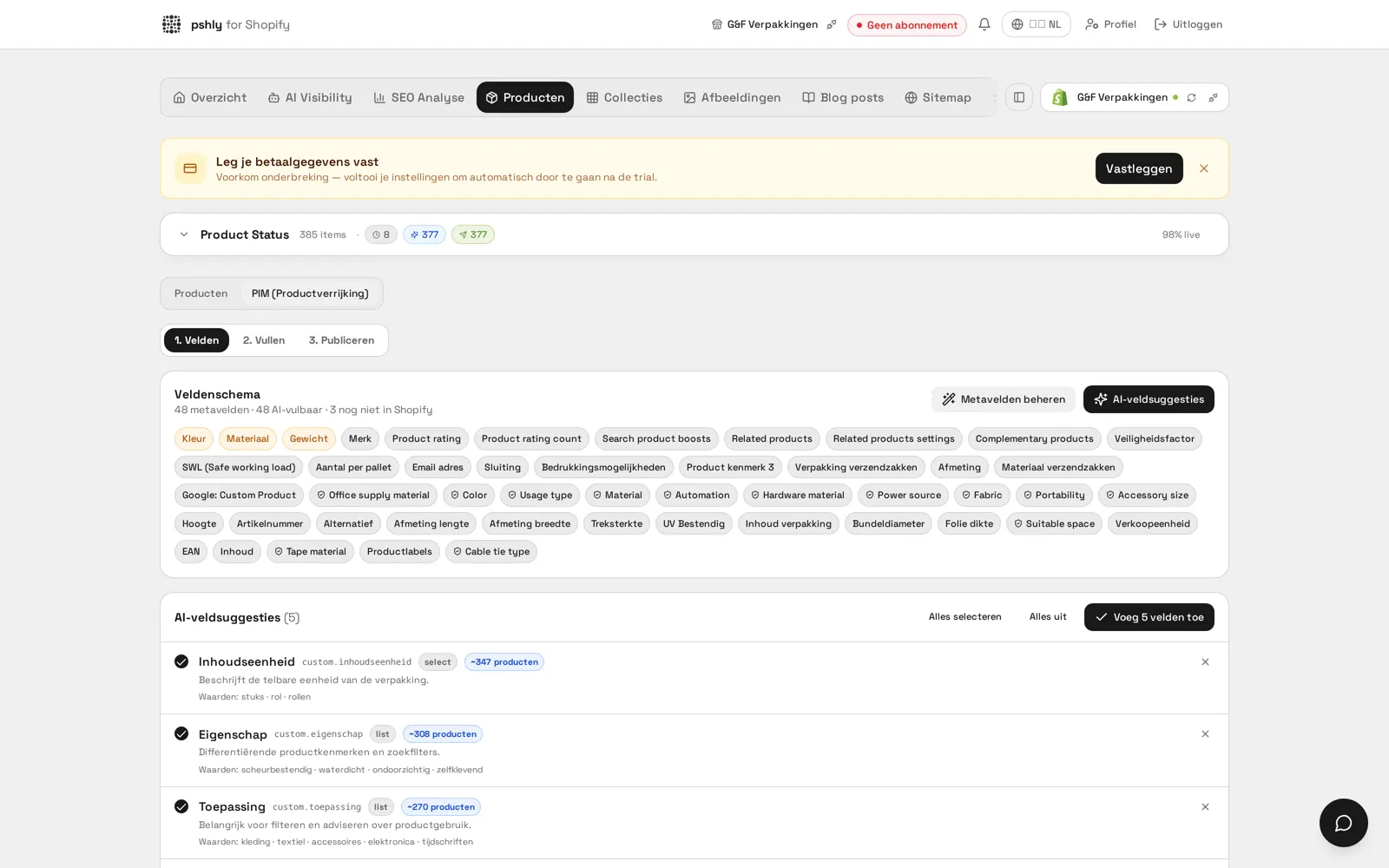
Fields — define your metafield schema
The AI analyses your full range based on existing product titles, descriptions and tags, and automatically suggests metafields. Existing Shopify metafields and taxonomy fields are recognised so you don’t start from scratch.
- AI field suggestions based on your actual product titles, tags and descriptions
- Shopify taxonomy fields (colour, material, target audience) automatically recognised
- Per suggestion: see how many products the field applies to
- Add in one click and sync directly to Shopify
Fill — bulk AI extraction
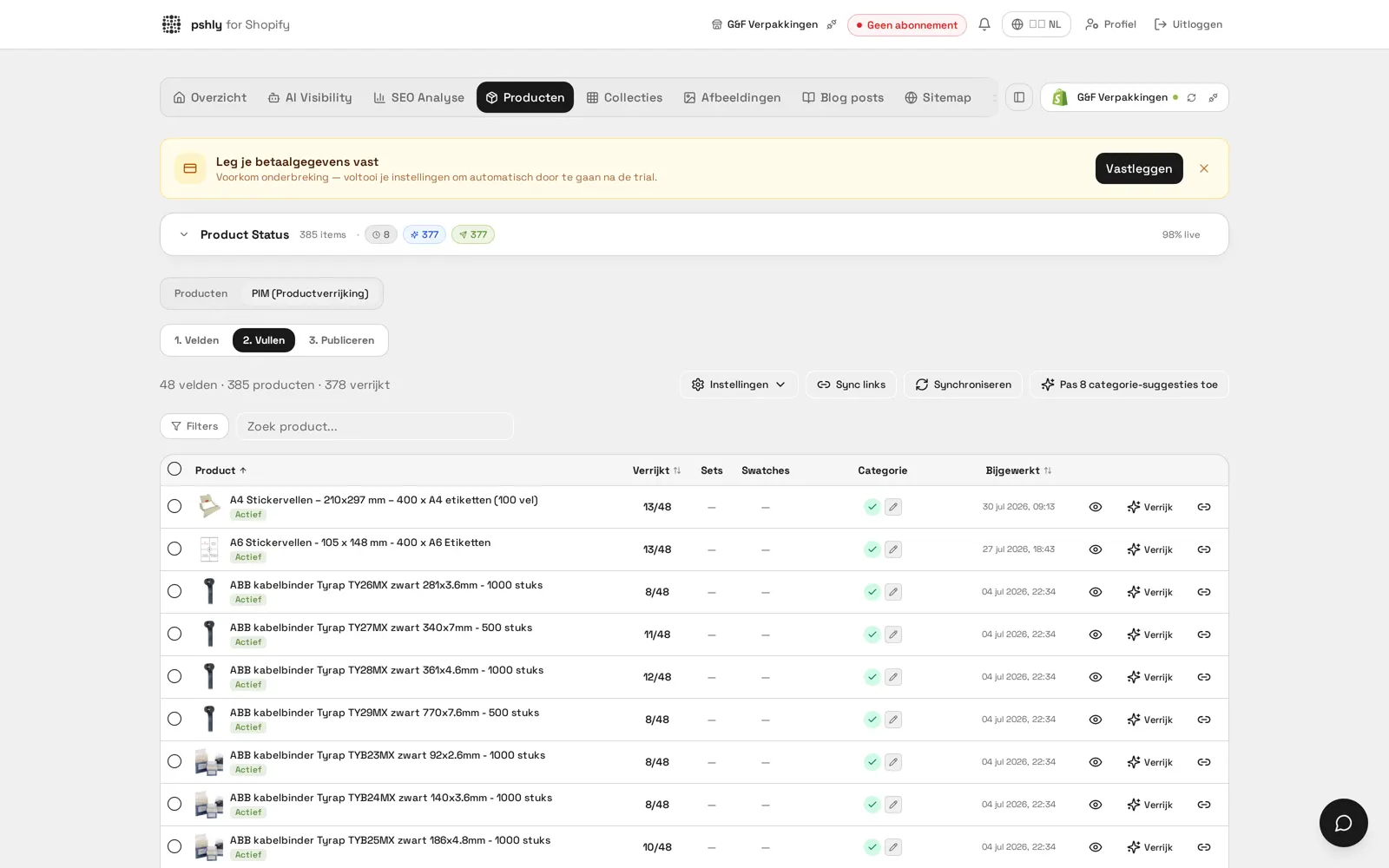
The AI reads each product’s title, description, tags and photos and fills metafields in bulk, server-side. Every value gets a confidence score — values below 70% are flagged for review.
- Bulk enrichment of hundreds of products simultaneously, server-side
- Confidence score and AI reasoning per filled value
- Filter on low confidence (<70%) and correct in bulk
- Including colour swatches, variants, category and linked sets
Publish — controlled delivery to Shopify
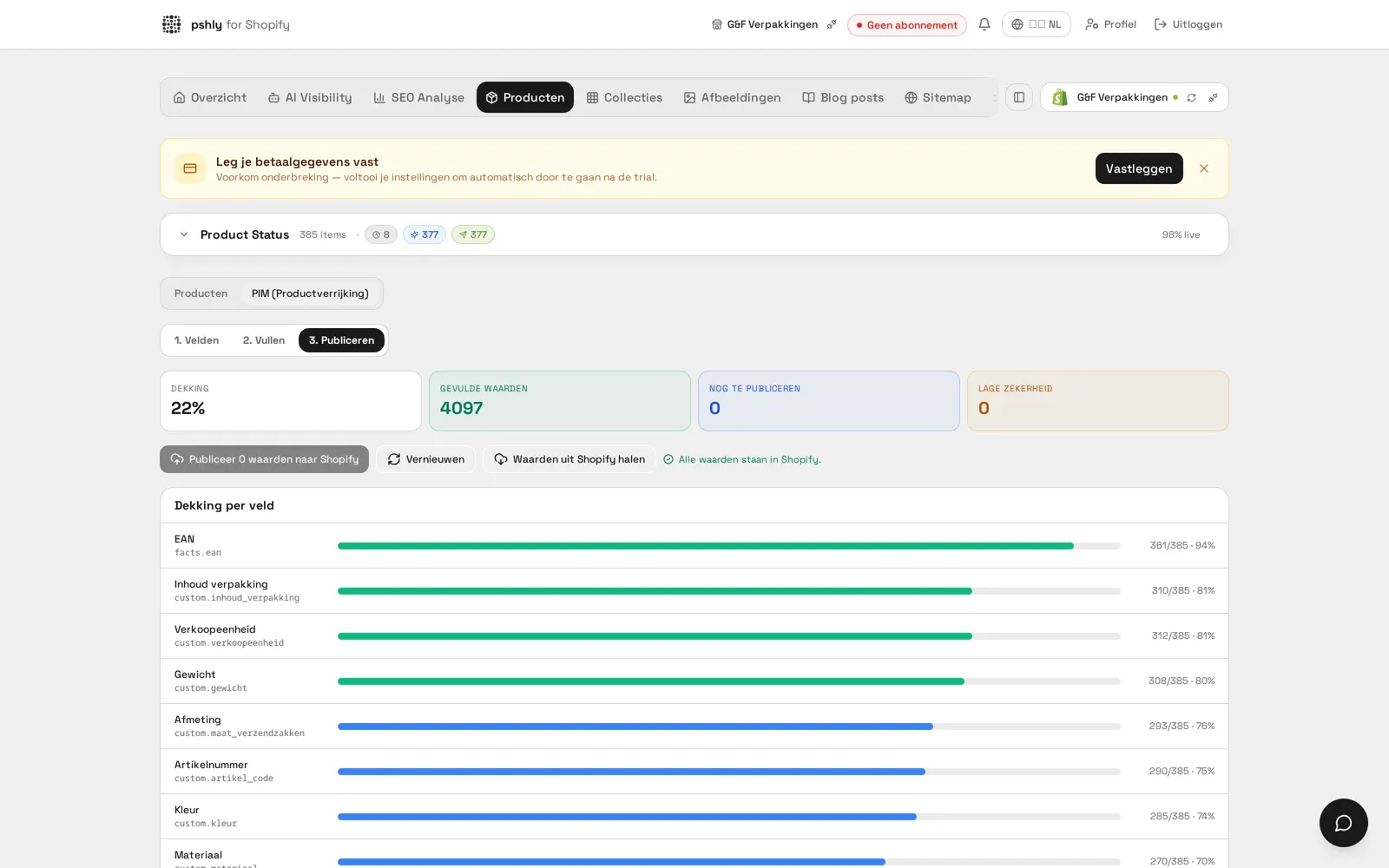
Before publishing, Pshly.ai shows a coverage overview per metafield with percentages and counts. Publish thousands of values in one batch — only approved values go live, fully logged.
- Coverage overview per metafield with percentages and counts
- Publish thousands of values to Shopify in one batch
- Only approved values go live — review stays mandatory
- Fully logged in job logs, always retrievable
For more on the technical workings of metafield enrichment, read Shopify metafields: how to auto-fill them with AI. Or get the full context in Shopify PIM explained.
Results: what does product data enrichment deliver?
Why Pshly.ai is the Shopify PIM — not just another integration
Traditional PIM systems like Akeneo or Salsify are built for enterprise environments that push data to dozens of channels. For a Shopify store, that means a separate database, a synchronisation layer, an implementation project, and ongoing maintenance — for features you’ll never use in Shopify.
Pshly.ai was developed by Web Builders, an official Shopify Partner, specifically for Shopify’s data structure and workflows. There’s no external database — product data lives in Shopify and stays there. No sync risk, no dual maintenance, no consultants needed to get started.
“Pshly.ai isn’t a PIM bolted onto Shopify. It’s a product information system built on top of Shopify itself.”
See the full capabilities on pshly.ai/en/shopify-pim or the Shopify PIM page.
Product data enrichment as part of Shopify SEO
Product data enrichment is one component of a broader Shopify SEO strategy. Technical SEO (crawlability, sitemap, canonicals), link building, and page authority all play a role — but without good product data, those efforts are less effective.
The order: enrich your product data first, then fix technical SEO issues, then build authority through content and link building.
See the Shopify PIM page for a complete overview, or book a free call to find out where the gains are in your catalogue.
Conclusion
Product data enrichment isn’t a nice-to-have — it’s the foundation of a Shopify store that gets found and bought from. Generic titles, empty metafields, and auto-generated meta descriptions cost you rankings and conversions.
With Pshly.ai, you enrich your catalogue at scale: AI fills in, you review, Shopify receives quality data. No manual work for hundreds of products, no external system, no migration.
Frequently asked questions
-
What does product data enrichment mean?
Product data enrichment means supplementing and improving existing product information: adding missing metafields, rewriting generic product titles, optimising meta descriptions for SEO, and consistently assigning product categories and collections.
-
Why is product data enrichment important for Shopify SEO?
Google evaluates product pages on completeness and relevance. A page with a strong keyword-targeted title, a unique meta description, filled-in metafields, and correct structured data consistently ranks higher than a page with generic content.
-
How long does it take to manually enrich Shopify product data?
For a catalogue of 500 products, manual enrichment (title, meta description, 4 metafields per product) easily takes 40 to 80 hours of work. With AI tools like Pshly.ai you reduce that to a fraction — and the quality is more consistent.
-
What is the difference between a product title and an SEO title in Shopify?
The product title in Shopify is the name visible on your product page. The SEO title (meta title) is the text that appears in Google. Shopify uses the product title as the SEO title by default, but you can set it separately via the SEO section per product. For good rankings, a separate keyword-targeted SEO title is recommended.
-
Can I improve existing Shopify product data in bulk?
Yes. Via Pshly.ai you enrich your full catalogue in bulk: titles, meta descriptions, metafields and categories are automatically generated and improved. After a review step, the improvements are pushed to Shopify in one go.
-
Why is Pshly.ai different from a traditional PIM system?
Traditional PIM systems like Akeneo or Salsify are built for multichannel enterprise setups — they require a separate database, a sync to Shopify, and often weeks of implementation. Pshly.ai is built on top of Shopify itself, by Shopify experts. There is no external system, no sync risk, and no implementation project.
- #shopify
- #product data
- #seo
- #metafields
- #product titles
- #meta descriptions
- #pshly
- #ai
- #shopify pim